Canned Grape Leaves in Brine — Private Label Supplier
Whole vine leaves, 9–18 cm, packed in an acidified brine with sodium ascorbate (E 301) in a 970 ml glass jar: 908 g net, 454 g drained, 24 months ambient. Supplied under your own brand.
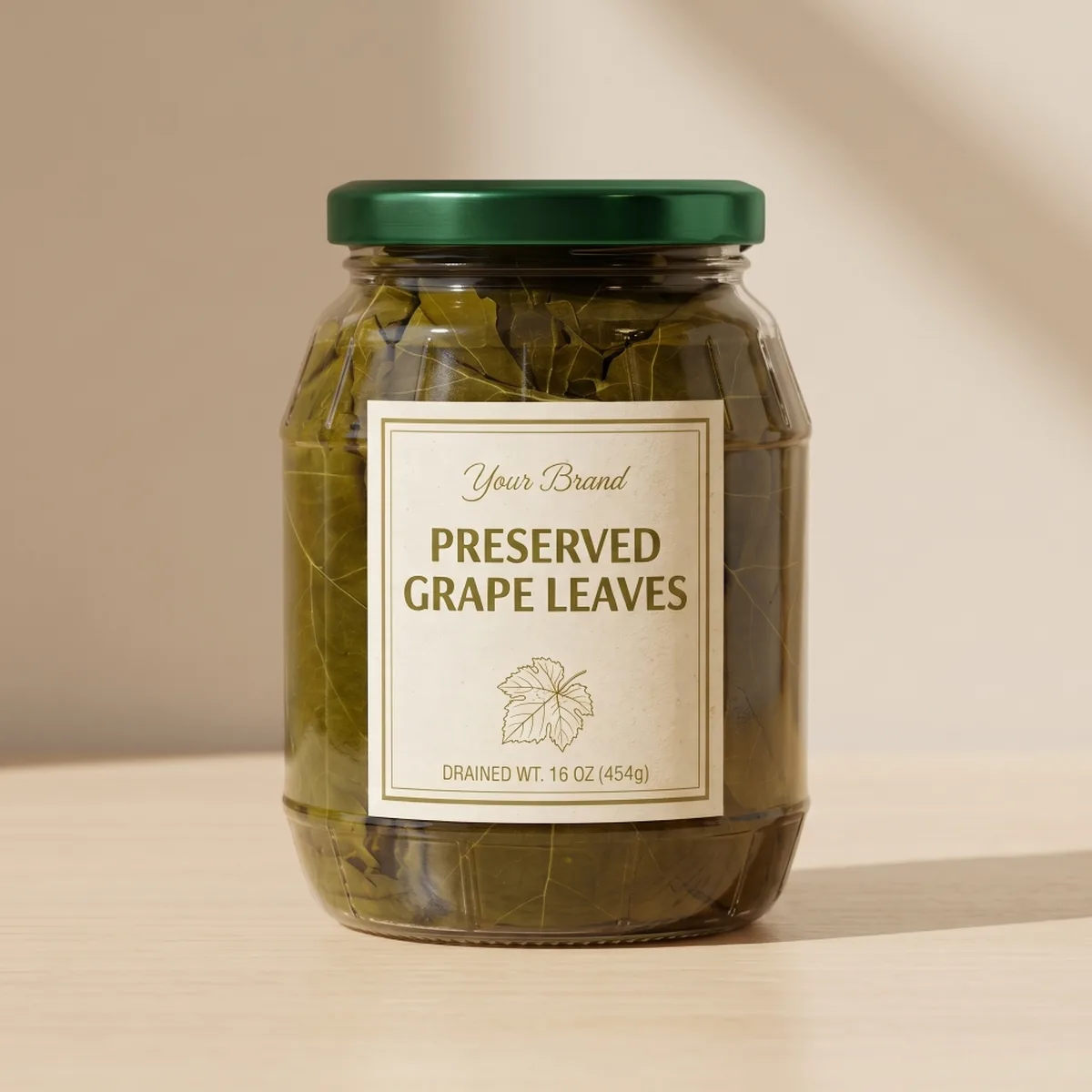
Placeholder label shown — the jar is supplied under your own brand and artwork.
Request a quotation Product page on kingstarfood.comSpecification at a glance
| Product | Canned grape leaves in brine (whole leaves) |
|---|---|
| Ingredients | Grape leaves, water, salt, citric acid, sodium ascorbate (E 301) |
| pH | 2.8 – 3.4 |
| Salinity | 4 – 6 % |
| Water activity (Aw) | ≥ 0.85 |
| Leaf diameter | 9 – 18 cm |
| Net weight | 908 g |
| Drained weight | 454 g |
| Unit pack | Glass jar, 970 ml |
| Jars per carton | 12 |
| Cartons per 40′ FCL | 1,470 |
| Shelf life | 24 months from production date |
| Production period | All year round |
| HS code | 2008.99 (2008 99 99) |
Loadability figures are issued by the packing plant and confirmed per order. The leaves are a single commercial grade at 9–18 cm; if your format needs a narrower band for a consistent count per jar, raise it before artwork because it is a supply question, not a print question.
What exactly is in a jar of Kingstar canned grape leaves?
A 970 ml glass jar holds 908 g net and 454 g drained of whole vine leaves, 9–18 cm, in an acidified brine of water, salt, citric acid and sodium ascorbate (E 301). Measured values on the specification are pH 2.8–3.4, salinity 4–6 % and water activity at or above 0.85, which is what carries the 24-month ambient shelf life without a cold chain.
Is sodium ascorbate (E 301) permitted in the EU for canned grape leaves?
Yes. Canned grape leaves in brine fall under food category 04.2.2 (fruit and vegetables in vinegar, oil or brine) of Annex II to Regulation (EC) No 1333/2008. That category authorises Group I additives, and Group I includes E 300 ascorbic acid, E 301 sodium ascorbate and E 302 calcium ascorbate at quantum satis — no maximum level is set. The same additive is listed at GMP in Table 3 of the Codex General Standard for Food Additives for category 04.2.2.3 (vegetables in vinegar, oil, brine or soy sauce). That is why this brine holds colour with an ascorbate rather than with a sulphite: the label declares no sulphites and the recipe is legal in the EU and in the Gulf without a second production run.
Which markets can take this specification without reformulation?
One brine serves the European Union, the GCC states and North America. The EU position rests on Annex II of Regulation (EC) No 1333/2008 (category 04.2.2, quantum satis); the Gulf position rests on national standards built on the Codex GSFA, which lists the same additive at GMP for the same category. Buyers therefore do not need a separate production run, a separate artwork or a separate lot for the EU and for the Middle East.
Can the jars carry our own brand and our own artwork?
Yes — this is a private-label (OEM) line, not a house brand. Artwork, label language and nutrition format are set by the buyer: Regulation (EU) No 1169/2011 nutrition declaration and drained weight beside net weight for European retail, or a bilingual Arabic and English label to GSO 9/2019 for Gulf retail. Label text is approved against the destination market's rules before the first print run.
What is the minimum order quantity and the lead time?
The minimum is one 20' FCL per variety; a 40' FCL carries 1,470 cartons of 12 jars. Lead time is typically 45–60 days from purchase-order confirmation, and loadability is confirmed per order before the quotation is fixed because glass is heavy freight and carton compression matters.
Which certificates and documents travel with each lot?
The packing plant holds BRCGS, IFS and Halal certification; the grade or level is read from the certificate copy that travels with the quotation, because a slide is not a certificate. Each shipment is accompanied by a certificate of analysis per batch, a certificate of origin, and a health or free-sale certificate, with embassy legalisation where the destination requires it.
Why is there no sulphite in the brine?
Colour in brined leaves is usually held with a sulphite — potassium metabisulphite (E 223) is common — and that declaration ends the conversation with any retailer whose specification excludes sulphites. Here colour is held by the acidified brine itself at pH 2.8–3.4 together with the ascorbate antioxidant, so the label declares no sulphites and the 24-month shelf life still holds.
How does a buyer verify the plant and the paperwork before ordering?
Start with the certificate itself rather than a supplier's summary: scheme, site name and address must match the packing plant, and the grade must be read from the certificate copy. Kingstar publishes a verification path for each of those checks — factory audit checklist, BRCGS/IFS certificate verification, import documents and payment controls — on the buyer-answers pages linked below.
What this page does not claim
- The line is not Kosher certified, so kosher and Israeli retail channels need a different programme.
- Certificate grades and levels are stated on the certificate copies, not summarised here.
- No market-size estimate is published for grape leaves, because no authority publishes one; the category numbers that do exist are trade statistics and shelf prices.
The additive position above was last checked on 2026-11-04 against the consolidated text of Regulation (EC) No 1333/2008 (Annex II) and the Codex GSFA (CXS 192-1995, Table 3, category 04.2.2.3).
Next step
Send the destination market, the pack format and the label brief; you get the specification sheet, the certificate copies and a quotation with drained weight and loadability confirmed for your order.
Request a quotation [email protected]